Forest City
In a recent meeting between Forest City developers and local residents, a landowner of 200 acres around West Wickham declared that her family’s estate was not for sale; and the developers replied, “The development corporation would decide that, as it would have the power of compulsory purchase” (as reported by Suffolk News). “Proposed new 370,000 home Forest City, between Haverhill and Newmarket, comes under fire at public meeting”. SuffolkNews. 6 March, 2026. https://www.suffolknews.co.uk/haverhill/news/new-city-proposal-described-as-desperately-damaging-to-the-9456134/.
This is the nature of the multibillion investment proposed by the Albion City Development Corporation (ACDC). Their goal? To flatten the Suffolk-Cambridgeshire border and make way for “400,000 homes”.
Surprisingly, on their five-person advisory board, there is no construction industry expertise, no accreditation from the Royal Institute of British Architects (RIBA), the Royal Institute of Chartered Surveyors (RICS) or from a Member of the Chartered Institute for Building (MCIOB). Instead, they’ve prioritised the contributions of economists and consultants:
-
- Dame Patricia Hewitt: former-Minister for Women and Equalities; Secretary of State for Trade and Industry; and Secretary of State for Health under Tony Blair.
In 2010, Hewitt was suspended in wake of the “cash for influence” scandal where she’d agreed to work for a fictitious lobbying firm in exchange for an exorbitant daily fee. - Dr Tim Leunig: a lecturer at the London School of Economics who advised Sajid Javid and Rishi Sunak during the COVID-19 pandemic.
Leunig is credited with conceiving of the furlough scheme which lost >£3 billion to fraudulent claims. - Steve McAdam: a senior advisor at the London Communications Agency, collaborating on their Kings Cross and Canada Water “refurbishments”.
In 2012, the Kings Cross redevelopment was found to have set quotas on incoming residents, excluding “families with children”, “those with drug/alcohol problems” and anyone “in rent arrears”; and the recently approved Canada Water redevelopment had to beg the Greater London Authority for an extra £50 million grant to maintain their 9% affordable housing provision. - Jackie Sadek: chair of The UK Innovation Corridor which is looking to expand collaboration between Cambridge and London, up and down the M11,
“Hosting clusters of hi-tech businesses.” - Paul Johnson: the current provost at Oxford University and a regular columnist for The Times.
- Dame Patricia Hewitt: former-Minister for Women and Equalities; Secretary of State for Trade and Industry; and Secretary of State for Health under Tony Blair.
Headed by Shiv Malik (a former journalist, now tech financier) and Joseph Reeve (an AI enthusiast turned lobbyist), this is the all-star team that’s planning to astroturf “45,000 acres” of rural land: “swallowing up” villages like Stetchworth; Dullingham; Wood Ditton; Great Wratting; West Wratting; the Thurlows; and more.
“[There’s] no planning application package, no published masterplan boundary, no environmental statement, no transport plan, no water-resource strategy with company sign-off.”
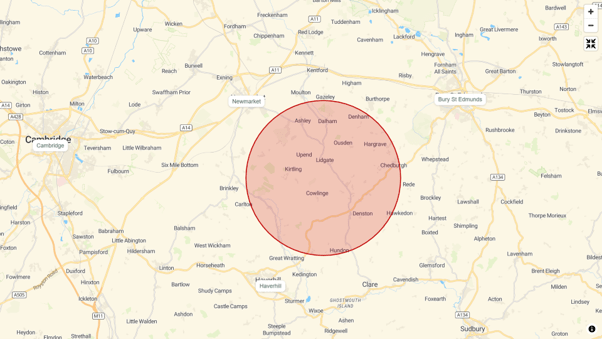
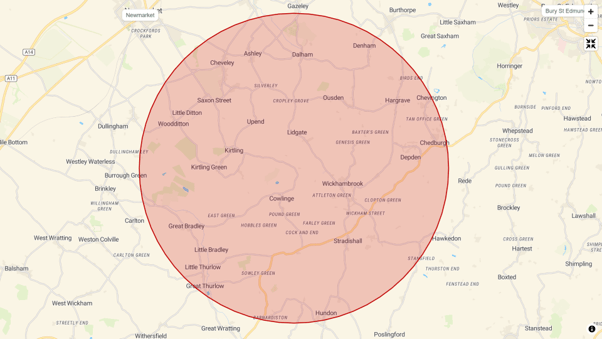
Forest City has delivered nothing short of an advertisement for their “privately-led” investment-driven development, dressed up as an answer to the housing crisis, that will displace >8,000 people and trash our verdant countryside.
A map for scale is available on the “Stop Forest City” website as the developers have yet to submit their own.
The proposed site would realistically fall between Newmarket, Haverhill and Bury St Edmunds, leaning more so towards Haverhill, roughly “the same footprint size as Bristol”.
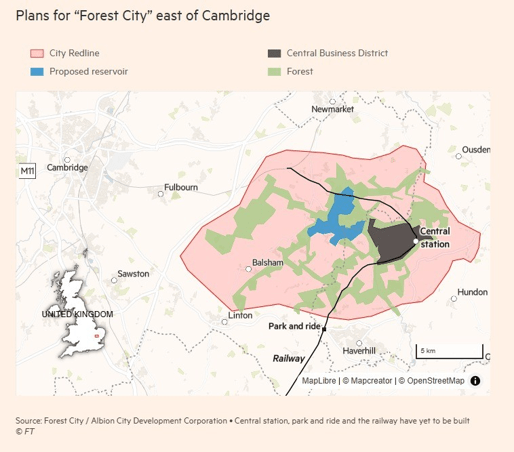
The only figures provided by ACDC are of the “wildlife corridors” planned around a central reservoir; a rough sketch of the “main urban areas” (a business district, two “secondary urban centres” and fourteen neighbourhoods); and a potential railmap (including three new stations: Cambridge East; Forest City; and Haverhill).
Most of the space marked out as the “major natural area” (the non-urban mass between Great Bradley, Carlton and Burrough Green) would be comprised of the 1,500 acre reservoir, and the “wildlife corridors” (in green) would function as an interlocking public footpath to connect the disparate neighbourhoods, spreading the already narrow branches of natural infrastructure over 70 square miles.
Roughly 25% of the total footprint (12,000 acres) is set aside for the “nature reserve” which is organised in such a way as to create residential boundaries, rather than to preserve or encourage wildlife—despite their assertions “to protect” any existing woodlands.
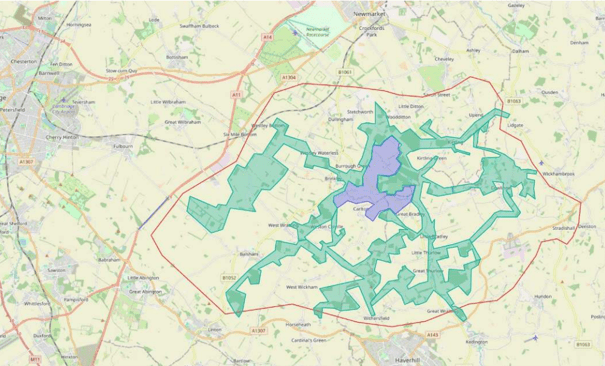
The developers admit,
“The Nature Reserve is situated more heavily in the West of the proposed area of Forest City, as this is where the greatest concentration of existing irreplaceable habitats can be found.”
The proposed distribution of natural space preserves a large buffer between Forest City and the Cambridge Green Belt, whilst carving into the areas surrounding Haverhill, Southeast Cambridgeshire and the West Suffolk border.
The planned “Great Bradley Reservoir” would hold up to 52 million m³ of water, roughly 55% of the development’s total needs, costing upwards of £2 billion and not planned for completion until 2040. This would appear incongruous with ACDC’s plans of building between 8,000-16,000 houses per year (depending on the extent of their planning permission), breaking ground in around 2030, optimistically, with 80,000-160,000 homes in need of plumbing before the reservoir is due to be operational.
Simply put, where will the natural resources come from?
Forest City has estimated that each household (on a 2.4 occupant average) would use 161-209 litres per day, accounting for 400,000 homes, that’s 64-84 megalitres per day. Including an extra 75 daily megalitres (of “non-household usage”) by 2050, that’s 139-159 megalitres per day—and at full capacity, the reservoir would only provide 87 megalitres per day.
ACDC have proposed an expansion of the Cambridge-Rede pipeline (which has yet to break ground, and due for completion in 2030) to provide Forest City with 20-30 megalitres per day, at the cost of £100 million.
Anglian Water has allocated £11 billion towards improving their infrastructure as East Anglia is known to be one of the driest regions in the country.
Until their Great Bradley reservoir can be completed, Forest City would have a detrimental impact on our region’s dependencies as their only feasible plan is to extract water from our surroundings. As such, the Environmental Agency has issued a generous warning that the developers should recoup 26 megalitres per day by 2050.
Furthermore, ACDC have proposed that the White Horse Reservoir pipeline could be extended to Forest City – providing another 20-30 megalitres per day – but the project isn’t due for completion until 2040, and the extension would cost £800 million.
The developers frequently reference “data centres” as if they’re a foregone conclusion and not up for debate. The proposed 600 MW centre in East Havering would use 96.24 megalitres per annum at full capacity, 263,687 litres per day, roughly the same as 1,261 households (at an upper estimate of 209 litres per day).
Thames Water estimates that 25% of London’s water usage is commercial. Forest City has proposed an eyewatering 75 megalitres per day (47% total) to account for their commercial plots and investments, expanding “Silicon Fen” into Suffolk.
Before 2040, the only potable water that’s available to Forest City is through a pipeline extension that has yet to be constructed.
Based on their current projections and excluding any commercial usage (which is instrumental to their development plan), only 95,693 homes could be built by 2040, assuming that the Cambridge-Rede pipeline supplies a lower estimate of 20 megalitres per day.
The multibillion budget for the Forest City development hinges on the fact that there is a housing shortfall, and the government is unable to meet their own quotas. In 2019, Boris Johnson successfully campaigned on the promise that 300,000 homes should be built every year “to rebalance the housing market”.
Without their own reservoir, ACDC would deliver <100,000 homes in a decade, building roughly 9,569 houses per year, 3.18% of the demand between 2030-40. Is it worth decimating 45,000 acres of rural land, and draining the coffers, for a development that barely scratches the surface of our housing crisis?
Their concept diagram is laughably crude and provides no real method to scale. Note that the proposed railmap connects Forest City to both Dullingham and Haverhill, and then to Stansted Airport.
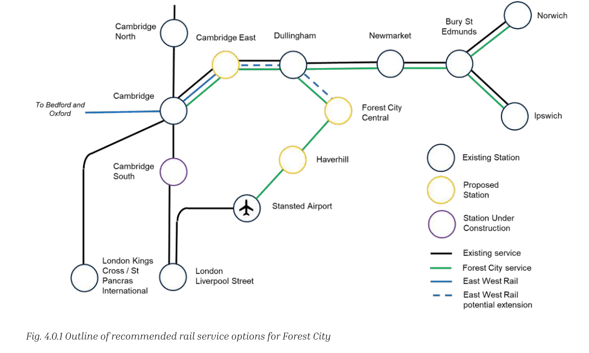
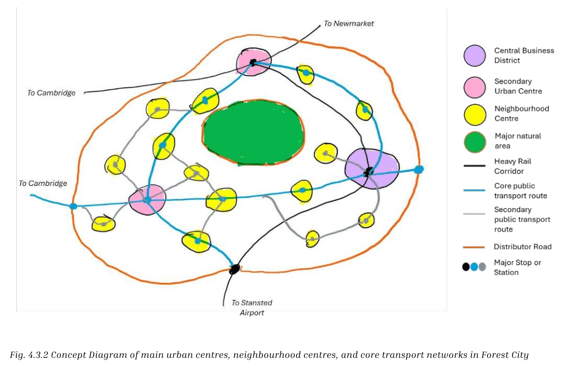
To avoid disturbing the reservoir, the link between Dullingham and Forest City would have to cut through their wildlife corridors (and neighbourhoods) in the northeast half of the development; likewise, the link between Forest City and Haverhill would disrupt the southeast half; and the connection to Stansted would cut through several main roads/villages, of which the government would supposedly intervene to “clear the way”.
ACDC have provided a lowball estimate of £8.61 billion—for their total transport costs—and a highball of £16 billion. This deficit would suggest they’ve not appropriately planned for the feasibility of implementing a heavy rail link between Dullingham and Stansted Airport (which already connects to both Cambridge and London, despite what their map says); double-tracking between Cambridge and Newmarket; transit lines throughout the development; Park and Ride sites; distributor roads and new highway networks; upgrades to several junctions (on the A10; A11; A14; and M11); freight consolidation centres; and traffic management systems.
Malik and Reeve refer casually to the “regeneration” of Stratford as evidence for why they should redevelop the landscape of Suffolk,
“More recently, we turned a wasteland into a world-class urban development […] And we, the British, did it in less than 20 years. The place? Stratford City, East London.”
To compare, Suffolk is far from an urban “wasteland” and 63 new builds within the Stratford development are facing a £432 million fire remediation bill that’s being contested by the Supreme Court.
At the time, prospective buyers were told they were acquiring “hot property” but even local estate agents have demurred,
“In [the] East Village, it’s become a lot more difficult to sell homes. People get stuck with properties. They want to move on with their lives but they get stuck so they end up becoming landlords even if they don’t want to be.”
Malik and Reeve both admit that the proposal is dependent on other developments in the area: the “East-West train line extension” which has yet to be finished, much like HS2; “an extension of the M11” which doesn’t exist, only junctions 7A (in Harlow) and 8 (around Bishop’s Stortford) have had major works completed so far; the expansion of Stansted airport, which is set to increase the total passenger cap from 43 to 51 million by 2040; the two pipeline extensions and another reservoir in Oxfordshire that ACDC would siphon water from.
Despite referencing the Kingsway Solar development (as pictured), which would eat into the western portion of Forest City, the developers fail to mention the 2,500 acre Sunnica Energy Farm which went up for sale in May of this year.
Energy is a nebulous concept to ACDC, they make a “conservative” claim of the development requiring 460 MVA at peak capacity, before conceding that “the electrical demands of the transport system and any heavy commercial users (e.g., data centres)” would balloon this figure.
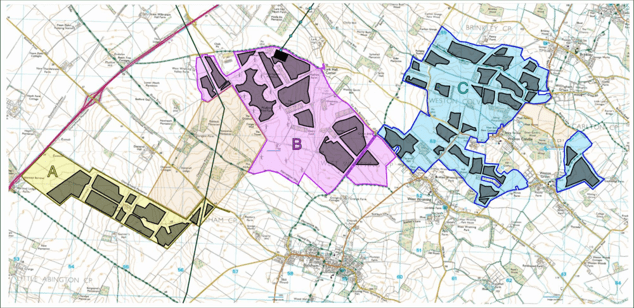
The total cost of providing energy infrastructure (to transmit electricity) is upwards of £2.8 billion, but ACDC admits that the nearest Grid Supply Point at Burwell is “already close to full capacity”.
To solve this deficit, they propose that Lithium Iron Phosphate batteries should be installed in every home as part of a “distributed battery fleet”, insinuating that the city would automate the use and proliferation of energy across several distinct neighbourhoods.
They also propose that Small Modular Reactors could be used to “solve for abundance”, peppering the countryside with flammable batteries, data centres and nuclear facilities.
Then, ACDC suggests that the area should be opened up to Advanced Geothermal Systems, to produce an underground thermal reservoir that would be capable of storing heat for the cooler months. Geothermal fracking poses the same risks in terms of pollution and induced seismicity, but Advanced Geothermal Systems pipe water into the Earth’s crust through a “closed-loop system”, eliminating much of the risk to contaminating natural aquifers—but the initial groundbreaking, “deep drilling” work is still required.
ACDC tells on themselves in their executive summary,
“As Stanford University is to Silicon Valley, so Cambridge University shall be to Forest City.”
Despite their naked desire to establish a technological hub in the heart of Suffolk, Forest City will simply not have access to the resources it needs to either solve the housing crisis or expand its investment portfolio.
Data centres and laboratories (much like houses and families) need water and energy. The only plan that ACDC has is to plug Forest City into the grid and wait for it to collapse, promising a reservoir by 2040 and alluding to the efficiency of “mini nukes”.
How much waste will Forest City have produced by the time that it can feasibly accommodate both residential needs and commercial interests? The developers seem to have no idea—or they simply don’t care.
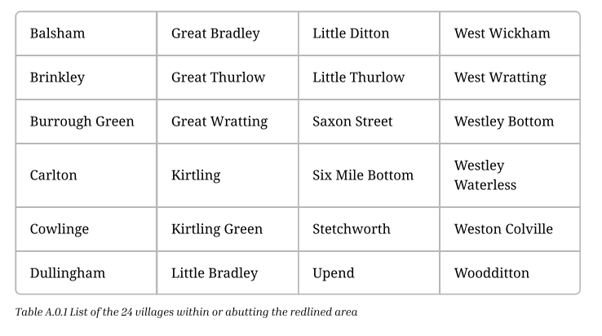
The definitive list of villages affected by Forest City are as follows:
Sources:
“Proposed new 370,000 home Forest City, between Haverhill and Newmarket, comes under fire at public meeting”. SuffolkNews. 6 March, 2026. https://www.suffolknews.co.uk/haverhill/news/new-city-proposal-described-as-desperately-damaging-to-the-9456134/
“Shiv Malik”. LinkedIn. https://www.linkedin.com/in/shivmalik/
“Joseph Reeve”. LinkedIn. https://www.linkedin.com/in/josephereeve/
“We Can Build a City”. Forest City 1. https://www.forestcity.uk/report
“Patricia Hewitt”. LinkedIn. https://www.linkedin.com/in/the-rt-hon-dame-patricia-hewitt-dbe-041b38161/
“Ex-ministers in ‘cash for influence’ row under fire”. BBC. 21 March, 2010. http://news.bbc.co.uk/1/hi/8578597.stm
“Tim Leunig”. LinkedIn. https://www.linkedin.com/in/tim-leunig/
“Tim Leunig”. LSE. https://www.lse.ac.uk/school-of-public-policy/people/Tim-Leunig
“Error and fraud in the COVID-19 schemes: methodology and approach (an update for 2023)”. GOV.UK. 17 July, 2023. https://www.gov.uk/government/publications/measuring-error-and-fraud-in-the-covid-19-schemes/error-and-fraud-in-the-covid-19-schemes-methodology-and-approach-an-update-for-2023#appendix-1-detailed-error-and-fraud-estimates
“Steve McAdam”. LinkedIn. https://www.linkedin.com/in/stevemcadam/
“PR consultancy LCA appoints McAdam as senior adviser”. PropertyWeek. 1 October, 2024. https://www.propertyweek.com/news/pr-consultancy-lca-appoints-mcadam-as-senior-advisor
“It’s social housing—so why are the needy locked out?” The Independent. 24 September, 2012. https://www.independent.co.uk/news/uk/home-news/it-s-social-housing-so-why-are-the-needy-locked-out-8166722.html
“Canada Water tests London’s resi temperature”. PropertyWeek. 1 April, 2026.
https://www.propertyweek.com/insight/leader/canada-water-tests-londons-resi-temperature
“Jackie Sadek”. LinkedIn. https://www.linkedin.com/in/jackie-sadek-591416161/
“The UK Innovation Corridor”. https://innovationcorridor.uk/
“Paul Johnson”. LinkedIn. https://www.linkedin.com/in/paul-johnson-5b698056/
“Paul Johnson”. The Times. https://www.thetimes.com/profile/paul-johnson
“Let’s build a city”. Forest City 1. https://www.forestcity.uk/plan.pdf
“Forest City 1”. Stop Forest City. https://www.stopforestcity.co.uk/forest-city-1
“Forest City 1 Map”. Stop Forest City. https://www.stopforestcity.co.uk/forest-city-1-map
“Cambridge to Rede FAQs”. Anglian Water. https://www.anglianwater.co.uk/environment/investing-in-the-future-of-water/strategic-pipeline-alliance/keeping-taps-flowing-for-future-generations/cambridge-to-rede-pipeline/cambridge-to-rede-faqs
“Planned mega-reservoir takes next step forward”. BBC. 13 May, 2026. https://www.bbc.co.uk/news/articles/c4g82ej249xo
“Non-Technical Summary”. East Havering Data Centre Campus. February, 2026. https://democracy.havering.gov.uk/documents/s83041/APPENDIX%209%20-%20Environmental%20Statement%20Non-Technical%20Summary.pdf
“Water efficiency for businesses”. Thames Water. https://www.thameswater.co.uk/wholesale/water-efficiency
“From Silicon Fen to world-leading networks: the Cambridge eco-system”. University of Cambridge: Judge Business School. 27 April, 2023. https://www.jbs.cam.ac.uk/2023/from-silicon-fen-to-world-leading-networks/
“Tackling the under-supply of housing in England”. UK Parliament. 19 May, 2023. https://commonslibrary.parliament.uk/research-briefings/cbp-7671/?utm_source=HOC+Library+-+Research+alerts&utm_campaign=2130d74e70-EMAIL_CAMPAIGN_2023_05_20_08_00&utm_medium=email&utm_term=0_a9da1c9b17-2130d74e70-%5BLIST_EMAIL_ID%5D&mc_cid=2130d74e70&mc_eid=48606c3260
“Olympic village ‘tainted’ by unsellable flats”. BBC. 19 May, 2026. https://www.bbc.co.uk/news/articles/c626l4ngv36o
“Council approves Stansted airport expansion plan”. BBC. 17 December, 2025. https://www.bbc.co.uk/news/articles/crmd89mjz0vo
“Useful resources”. Kingsway Solar Community Action. https://kingswaysolarcommunityaction.co.uk/useful-resources/
“Solar farm delay causing ‘fear and uncertainty’”. BBC. 2 January, 2026. https://www.bbc.co.uk/news/articles/cvgqkewqql7o
“Campaigners puzzled by decision to sell controversial Sunnica solar farm and battery plant, near Newmarket”. Suffolk News. 8 May, 2026. https://www.suffolknews.co.uk/newmarket/news/controversial-sunnica-solar-scheme-is-up-for-sale-9464708/
“Hydraulic Fracturing & Health”. National Institute of Environmental Health Sciences. https://www.niehs.nih.gov/health/topics/agents/fracking
“What are small nuclear reactors and why does the UK want to build them?”. BBC. 10 June, 2025. https://www.bbc.co.uk/news/articles/c62614wejk5o
“‘Bonkers’: the audacious plan for a one-million person city near Cambridge”. Financial Times. May 29, 2026. https://www.ft.com/content/e50ffbb3-45e7-4eb1-a82a-f7e93594d18f?syn-25a6b1a6=1